Somewhere in a jewelry box in a home near you, there is almost certainly a piece that has outlived the person who first wore it. A ring passed from grandmother to granddaughter. A brooch that traveled from one coast to the other inside a moving box that contained someone's entire life. A necklace that was never for sale at any price, because its value was never denominated in dollars.
This is what jewelry, at its most serious, actually is: not a fashion accessory, not a status marker, not a seasonal purchase. It is a vessel for human continuity. And the question of which pieces earn that role — which survive long enough, and matter deeply enough, to become heirlooms — is fundamentally a question of craft.
At Anelli Nagaoka, this question sits at the very center of everything we do.
The Fast Fashion Problem, Applied to Jewelry
The democratization of jewelry over the past two decades has been, in many respects, genuinely positive. More people than ever have access to beautiful objects at accessible price points. But the same forces that gave us fast fashion have infiltrated the jewelry market with consequences that are less immediately obvious and considerably more lasting.
Fast jewelry — thin gold vermeil over base metal, machine-set stones with minimal prong support, finishes that photograph beautifully and tarnish within a season — is not a neutral choice. It is a choice that trains the consumer to think of jewelry as ephemeral, as interchangeable, as ultimately disposable. And once that framework takes hold, the idea of a piece lasting a lifetime begins to seem not aspirational but simply impractical.
This is the cultural moment into which the Japanese manufacturing philosophy enters with something close to a corrective.
What Japanese Craftsmanship Standards Actually Mean
The concept of monozukuri — often translated as "the art of making things" but carrying connotations far closer to "the soul of making things" — is not a marketing term. It is a manufacturing philosophy embedded in Japanese industry at every level, from automotive engineering to textile production to, crucially, fine jewelry.
At its core, monozukuri demands that every stage of production be treated as worthy of the maker's full attention. There is no such thing as a step that is "good enough" because it will be covered by the next step. There is no acceptable shortcut when the shortcut introduces a structural compromise, however invisible that compromise may initially appear.
In the context of jewelry, this philosophy manifests in ways that are both visible and invisible to the wearer. Visible: the mirror-bright finish on a hand-polished gold band, the perfect symmetry of a pavé stone arrangement, the precise tension of a clasp mechanism that opens and closes with the same satisfying resistance after a decade of daily wear. Invisible: the thickness of the metal walls, the depth of the prong settings, the integrity of the solder joints at every connection point.
These invisible qualities are precisely the ones that determine whether a piece survives fifty years or five.
Precision Stone-Setting as a Long-Term Investment
Consider the specific case of stone setting, because it illustrates the investment argument more concretely than perhaps any other element of jewelry construction.
A diamond set in a thin, machine-pressed prong is a diamond at risk. Over years of wear, those prongs flex. They catch on fabric, on gloves, on the lining of a handbag. Eventually — and the timeline varies, but the outcome is predictable — a prong bends, a stone loosens, and if the wearer does not notice in time, the stone is lost. The piece may be repaired, but it is never quite the same.
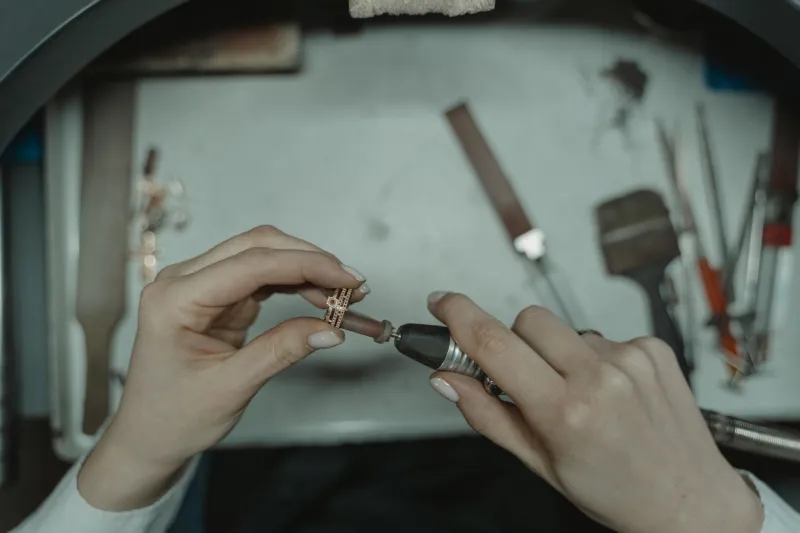
A diamond set by a craftsman trained in the Japanese tradition of hand-finishing, where each prong is individually shaped, burnished, and inspected before the piece leaves the bench, occupies an entirely different risk profile. The metal is worked to precisely the thickness required for structural integrity. The prong tips are rounded and polished not merely for aesthetics but to reduce the friction that causes them to catch and bend. The stone, once set, does not move.
This is not a subtle difference in quality. Over a thirty- or fifty-year timeline, it is the difference between a piece you hand down and a piece you repair into obsolescence.
Timelessness Is a Design Decision
Craft alone does not make an heirloom. A piece must also be designed with the future in mind — and this is where the Japanese aesthetic sensibility makes its second, equally significant contribution.
Japanese design has always been skeptical of trend. Not because Japanese designers are indifferent to contemporary culture — quite the opposite — but because the most respected Japanese design tradition holds that the truest forms are those that transcend the moment of their creation. A tea bowl made in the sixteenth century does not look dated. A Shaker chair does not look dated. A piece of jewelry designed with the same commitment to essential form over fashionable detail will not look dated in 2075.
The Italian goldsmithing tradition contributes something complementary here: a deep archive of forms — the signet ring, the link bracelet, the solitaire pendant — that have proven their endurance across centuries of changing taste. When Japanese precision is applied to these enduring Italian forms, the result is jewelry that is simultaneously of its moment and beyond it.
This is not accidental. At Anelli Nagaoka, it is the explicit design brief.
The Mathematics of the Heirloom
American consumers are, rightly, value-conscious. The argument for investing significantly in a single piece of fine jewelry rather than accumulating multiple pieces at lower price points deserves to be made in practical terms, not merely romantic ones.
A well-constructed piece of fine jewelry — one built to Japanese quality standards, designed with enduring form, and maintained with periodic professional care — does not depreciate in the way that fast fashion jewelry does. Precious metals hold intrinsic value. Diamonds and fine colored stones hold or appreciate in value over time when properly set and preserved. The craftsmanship premium paid at the point of purchase is not lost; it is encoded into the object's longevity.
More importantly, the cost-per-wear calculation over a lifetime of use renders the investment rational by almost any measure. A piece worn three hundred days a year for forty years has been worn twelve thousand times. Amortized across twelve thousand wearings, even a significant initial investment becomes, mathematically, negligible.
But the deepest return is not financial. It is the moment, decades from now, when someone who loves you holds something you chose with care and feels, through the weight of well-made gold and the clarity of a precisely set stone, the presence of your judgment and your taste.
That is the return no balance sheet can capture. And it is the one that matters most.