Forged in Patience: The Japanese Artisans Redefining American Fine Jewelry from the Inside Out
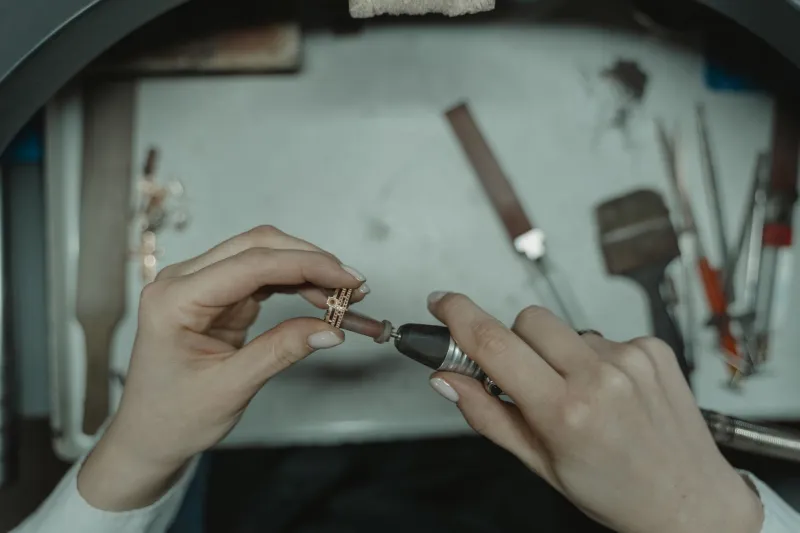
Behind some of America's most coveted fine jewelry collections, there are workshops in Japan where time moves differently. Apprenticeships measured in decades, tolerances measured in fractions of a millimeter, and a philosophy of craft that treats imprecision not merely as error but as failure of character. This is the hidden architecture beneath the most exceptional pieces reaching American collectors today.
To understand why Japanese metalwork commands the premiums it does in the American luxury market, one must first understand what the workshop environment actually demands of those who enter it—and how those demands shape every object that eventually leaves it.
The Apprenticeship as Foundation
In the most respected Japanese metalworking traditions, formal mastery is not conferred by a certificate or a degree program. It is earned through proximity—years spent in close observation of a master craftsperson before a student is permitted to attempt the techniques independently. This system, rooted in the broader Japanese apprenticeship tradition known as shokunin culture, treats knowledge as something that must be absorbed through the body, not merely the intellect.
A new apprentice in a Kyoto or Tokyo metalworking atelier may spend the first year performing tasks that seem entirely peripheral to jewelry: maintaining tools, preparing materials, observing. The philosophy behind this apparent inefficiency is precise. Before a craftsperson can make decisions about metal, they must understand metal—its behavior under heat, its resistance under pressure, the way it responds to the specific instruments of the workshop. That understanding cannot be rushed, and it cannot be taught through instruction alone.
By the time such an apprentice is entrusted with a significant commission, they may have spent a decade in preparation. The result, for the American collector who eventually wears the finished piece, is an object shaped by a quality of attention that has no commercial shortcut.
The Techniques That Set Japanese Metalwork Apart
Within the workshop, several specific techniques distinguish Japanese fine metalwork from its Western counterparts—and explain why American jewelry brands increasingly seek out Japanese artisans as the silent foundation of their most exclusive offerings.
Mokume-gane, the ancient laminating technique that fuses layers of differently colored metals into a single billet, producing patterns that resemble wood grain, is perhaps the most visually striking. Developed in seventeenth-century Japan for decorative sword fittings, the technique requires precise control of temperature and pressure during the lamination process. Even minor deviations produce visible inconsistencies in the final pattern—inconsistencies that cannot be corrected after the fact. The technique rewards only those who have internalized its demands completely.
Migaki, the hand-polishing process used to achieve the flawless mirror surfaces characteristic of high-end Japanese metalwork, is less visually dramatic but equally demanding. Unlike machine polishing, which produces a consistent but slightly mechanical finish, migaki is performed with a series of progressively finer abrasives applied by hand, each stage building on the last. The craftsperson must feel the surface as much as see it. The process for a single ring can consume several hours. There is no faster version that produces the same result.
Beyond specific techniques, Japanese metalwork is distinguished by its approach to tolerances. In workshops supplying the American fine jewelry market's upper tier, dimensional accuracy is routinely held to tolerances that would be considered extraordinary in most Western manufacturing contexts. Prong heights, bezel walls, stone seat depths—each is measured and verified not as a quality-control formality but as a fundamental expression of respect for the finished object.
How These Standards Reach the American Market
For American jewelry brands and independent designers seeking to differentiate themselves at the highest price points, the relationship with Japanese workshops operates in several distinct ways.
Some brands commission finished pieces directly, supplying designs that are then realized entirely within the Japanese workshop system. Others engage Japanese artisans for specific technical elements—a particularly demanding stone setting, a complex hinge mechanism, a surface treatment that requires capabilities unavailable domestically—while completing other aspects of production closer to home. In both cases, the Japanese workshop's contribution is rarely advertised prominently. It is, in the truest sense, the secret architecture.
This discretion is itself culturally significant. The shokunin tradition does not encourage self-promotion. The work speaks; the maker recedes. For American brands navigating a market that is simultaneously hungry for authenticity and suspicious of overt claims, the arrangement suits both parties. The brand acquires genuine craft credibility. The Japanese artisan community receives the commercial recognition that sustains its workshops without compromising the values that define them.
What Premium Pricing Actually Reflects
American consumers accustomed to evaluating jewelry through the lens of stone quality and metal weight sometimes find the pricing of Japanese-crafted fine jewelry initially puzzling. The pieces may not be the heaviest. The stones may not be the largest. Yet the prices reflect something that carat weight and gram count cannot capture: the cost of irreplaceable human expertise applied with absolute consistency.
Consider the economics of a ten-year apprenticeship. The knowledge embedded in a master craftsperson's hands represents an investment—personal, financial, and temporal—that has no equivalent in industrial production. When that expertise is applied to a single piece, the collector is not simply purchasing materials and assembly. They are purchasing access to a lineage of accumulated judgment, to decisions made correctly thousands of times before this particular object was ever begun.
For collectors who understand this, the premium is not a mystery. It is the most transparent pricing in luxury: you are paying for time, and time, in the end, is the only thing that cannot be manufactured.
Recognizing the Standard in the Finished Piece
For those building or refining a fine jewelry collection, understanding what Japanese workshop craftsmanship looks and feels like in a finished piece is a practical skill worth developing. Several indicators are consistent across high-quality Japanese metalwork.
Surfaces will be even and continuous, with no perceptible transitions between polished and unpolished areas. Stone settings will be flush or precisely elevated, with no variance in prong height visible to the naked eye. Interior surfaces—the parts of a ring or bracelet that rest against the skin—will receive the same attention as exterior faces. In lesser work, interior surfaces are frequently an afterthought. In Japanese workshop production, they are simply part of the object.
Finally, and perhaps most tellingly, the piece will have a quality of stillness. It will not demand immediate attention. It will, instead, reward sustained attention—the kind that comes with ownership, with daily handling, with years of living alongside an object that was made to endure precisely that intimacy. That quality, more than any single technique, is the signature of Japanese precision at its most accomplished.