The Mechanism Is the Message: Why Serious Collectors Now Judge Jewelry by What They Cannot See
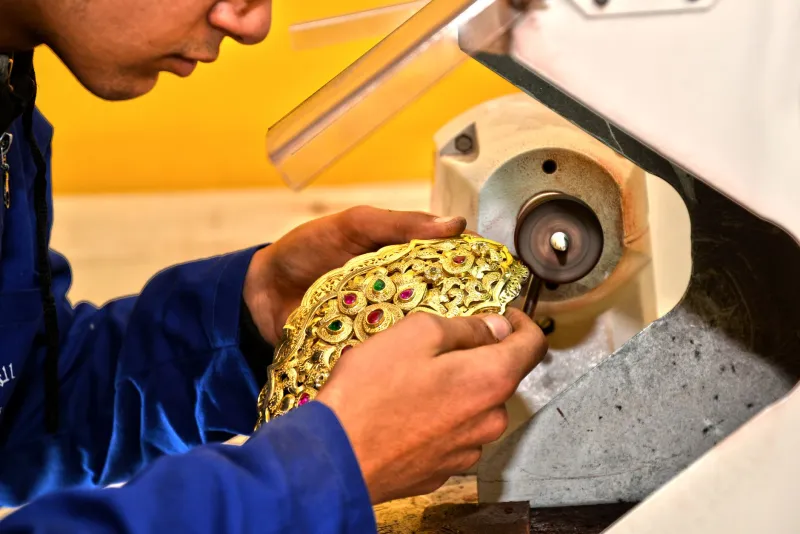
For generations, the educated eye has appraised a jewel by its stone, its setting, its silhouette. Yet a quieter revolution is underway among the most discerning collectors, one that directs attention to the fold of a clasp, the tension of a hinge, the silent precision of a lock. At Anelli Nagaoka, we believe the closure is not a footnote — it is the sentence itself.
The conversation around luxury jewelry has long been dominated by what is visible: the clarity of a diamond, the depth of a sapphire's color, the fluidity of a hand-wrought gold chain. These are worthy subjects. But they have, perhaps, overshadowed an equally profound dimension of craftsmanship — the mechanical architecture that holds everything together. A closure is not merely functional hardware. In the hands of a master metalworker trained in Japanese precision traditions, it becomes an argument for a different kind of beauty entirely.
Where Sword Meets Clasp
To understand why Japanese metalworking techniques are transforming luxury closures, one must first appreciate the lineage from which those techniques descend. For centuries, Japanese sword-makers — the tosho — developed methods of folding, tempering, and finishing steel that demanded an almost meditative relationship between craftsman and material. The goal was never decoration alone. It was the creation of an object that performed flawlessly under pressure, whose internal integrity was inseparable from its outward form.
This philosophy migrated, over the twentieth century, into Japan's extraordinary watchmaking culture. The micro-engineering required to produce a movement that loses no more than a few seconds per month is not entirely unlike the discipline required to craft a box clasp that opens with the same satisfying resistance after twenty years of daily wear as it did on the day it left the workshop. The tolerance for imprecision, in both traditions, is effectively zero.
At Anelli Nagaoka, our artisans draw directly from this inheritance. "When we design a closure," explains one of our senior metalworkers, who trained for over a decade in Niigata before joining our atelier, "we are not thinking about the clasp in isolation. We are thinking about the force a wrist applies when it moves, the way humidity affects metal contraction in different American climates, the number of openings and closings a piece might endure across a lifetime. The mechanism must answer all of these questions before it answers the question of how it looks."
The Italian Counterpoint
If Japanese precision provides the internal logic of our closures, Italian design sensibility provides their outward language. Italy's goldsmithing tradition — centered historically in cities such as Valenza, Arezzo, and Vicenza — has always prized the visible elegance of hardware. An Italian-trained designer understands that a clasp seen at the nape of a woman's neck at a dinner in Manhattan is as much a part of the composition as the pendant resting at her collarbone.
The synthesis Anelli Nagaoka pursues is not a compromise between these two traditions. It is, rather, an amplification of both. Our closures are engineered to Japanese mechanical standards and resolved to Italian aesthetic ones. A box clasp, for instance, might feature the kind of spring-loaded tongue tension that a watchmaker would recognize — calibrated to release under precisely the right lateral pressure, no more — while its exterior face carries the sculptural confidence of a Florentine brooch, finished by hand to catch light at angles that feel almost accidental.
The Collector's New Literacy
Among the clientele who seek out Anelli Nagaoka's pieces in the United States, we have observed a meaningful shift in how purchasing conversations unfold. A decade ago, a collector might spend forty minutes discussing gemstone provenance and perhaps two minutes, if that, on the closure. Today, we regularly encounter clients who arrive having already researched closure types — who can distinguish a lobster clasp from a trigger clasp, who know to ask whether a hinge is riveted or welded, who understand that a toggle bar that wobbles even slightly is a sign of compromised craftsmanship rather than an acceptable variance.
This is not pedantry. It reflects a maturing understanding of what luxury actually means. A piece of fine jewelry is not a painting to be admired from a distance. It is an object that lives on the body, subject to movement, moisture, and the accumulated pressures of a life fully lived. The closure is where that life is most directly tested. A stone does not typically fail. A poorly engineered clasp will.
"I ask every client to open and close the clasp themselves before they leave the atelier," says another of our craftspeople, who oversees final quality assessment. "Not because I expect them to find a problem — by that stage, the piece has been tested many times — but because I want them to feel what precision feels like. Once you have felt a perfectly calibrated mechanism, you cannot unfeel it. It changes what you expect from every piece you encounter afterward."
Hardware as Heirloom
There is a longer argument embedded in this conversation, one that speaks to how Americans increasingly think about luxury investment. The market for pre-owned fine jewelry has expanded significantly over the past decade, and with it has come a more rigorous scrutiny of structural integrity. Estate pieces that command the highest prices at auction — and in the secondary market more broadly — are almost invariably those whose closures remain as functional as their aesthetic elements remain beautiful.
This is the promise that precision metalworking makes across time. A closure engineered to Japanese standards of tolerance, resolved through Italian design intelligence, does not merely serve the original owner. It serves every owner the piece will ever have. It is, in a very literal sense, what allows a jewel to outlast a generation.
At Anelli Nagaoka, we design for that duration. We design for the moment, forty years from now, when someone opens a clasp for the first time and finds it still speaks the same language of precision it spoke when it left our hands. That is not a small ambition. But then, neither is the tradition from which it comes.