The Beautiful Imbalance: How Asymmetrical Jewelry Became America's Most Sophisticated Statement
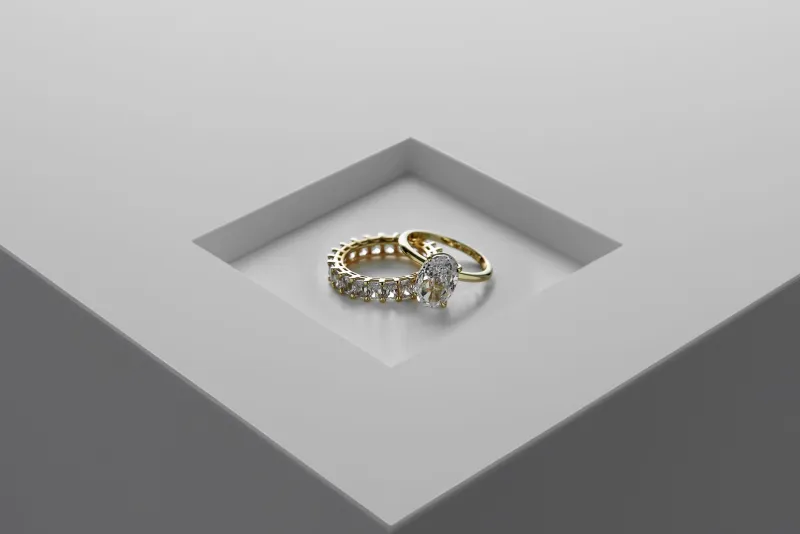
There is a particular kind of discomfort that precedes genuine appreciation. A piece of music that resolves unexpectedly, a painting whose focal point refuses to center itself, a sentence that ends before you expect it to — these are the gestures that linger longest. In fine jewelry, that discomfort has a name, and American collectors are paying a premium for it. Asymmetry, once considered an anomaly or an error of craft, has become the most reliable signal of considered taste.
At Anelli Nagaoka, where the discipline of Japanese precision is held in constant conversation with the expressive fluency of Italian design, asymmetry is not an aesthetic accident. It is a philosophy rendered in metal and stone.
Wabi-Sabi as Design Language
To understand why imbalance has become a marker of sophistication, one must first understand wabi-sabi — the Japanese worldview that locates beauty in impermanence, incompleteness, and irregularity. It is a philosophy that resists the tidiness of the Western decorative tradition without rejecting elegance entirely. Applied to jewelry design, wabi-sabi does not produce rough or unfinished work. Rather, it produces work that acknowledges its own incompleteness as a feature rather than a flaw.
A ring whose stone sits slightly off-axis. A cuff whose two terminals do not mirror each other precisely. An earring whose cascade of pavé diamonds trails longer on one side than the other. These are not mistakes. They are invitations — moments where the eye is asked to do something more than simply confirm what it already expects.
Japanese master craftspeople have long understood that the hand's slight variation across a surface communicates life in a way that machine-perfect repetition cannot. When that sensibility meets the sculptural boldness of Italian modernist design, the result is jewelry that carries intellectual weight without sacrificing wearability.
The Italian Contribution: Space as Material
Italian jewelry design, particularly as it evolved through the mid-twentieth century in cities like Milan and Florence, introduced the concept of negative space as an active compositional element. Rather than filling every available surface with ornament, Italian designers began treating the empty areas of a piece — the voids between forms, the gaps between clusters — as materials in their own right.
This approach translated naturally into asymmetrical composition. When negative space is doing real work, a piece no longer needs bilateral symmetry to feel resolved. The eye moves differently through such a design: not confirming a mirror image, but tracing a journey. Proportion replaces repetition as the governing principle, and proportion is, by its nature, a more complex and more rewarding kind of order.
For the American collector accustomed to jewelry that announces itself immediately, this shift requires a certain patience. But those who have made the adjustment rarely return to symmetrical forms with the same enthusiasm. There is something irreversible about learning to read imbalance as intention.
What American Collectors Are Actually Seeking
The American luxury market has undergone a quiet but significant transformation over the past decade. The collector who once sought jewelry that broadcast status through scale and symmetry has been joined — and in many categories, supplanted — by a collector who seeks complexity within restraint. This new collector is not minimalist in the self-denying sense. They want pieces that reward extended attention, that change character with different light, that feel different on the body at different moments.
Asymmetrical design serves all of these desires simultaneously. A piece that is not symmetrical cannot be absorbed in a single glance. It holds something back. It requires the wearer to develop a relationship with it over time, which is precisely the kind of ownership experience that discerning collectors are now prioritizing over simple possession.
This is also, not coincidentally, a generation of collectors who have grown comfortable with ambiguity in other domains — in architecture, in fashion, in music. The jewelry that speaks to them most fluently is jewelry that carries a similar willingness to leave questions open.
Proportion, Negative Space, and the Grammar of Restraint
Designing an asymmetrical piece that succeeds is considerably more demanding than designing one that balances. Symmetry offers a built-in scaffold: what works on one side can be confirmed by its reflection. Asymmetry offers no such assurance. Every element must justify its position through its relationship to every other element, and the eye must be guided through the composition without the comfort of repetition.
The designers who do this well think in terms of visual weight rather than literal measurement. A single large stone on one side of a composition may be balanced not by an equivalent stone on the other, but by a constellation of smaller elements — or by nothing at all, if the negative space is substantial enough to assert its own presence. This is design thinking of a high order, and the pieces it produces carry that intelligence in a way that is perceptible even to those who cannot articulate why.
For collectors building a wardrobe of fine jewelry, asymmetrical pieces function as what stylists sometimes call "anchor exceptions" — pieces that do not follow the visual logic of everything around them, and which therefore elevate the pieces that do. A perfectly symmetrical strand of pearls reads differently when worn alongside an asymmetrical earring. The contrast is not conflict; it is dialogue.
Building Toward Asymmetry
For collectors who are new to asymmetrical design, the most reliable entry point is the single statement earring — worn alone or paired with a smaller, simpler piece on the opposite ear. This format has moved well beyond novelty into genuine wardrobe utility, and it offers an immediate education in how visual imbalance can feel not chaotic but composed.
From there, the collector might explore rings whose stone placements challenge the center, or necklaces whose pendant elements drift deliberately off-axis. Each piece is an argument for a different kind of beauty — one that asks more of its wearer and, in return, offers considerably more in kind.
At Anelli Nagaoka, we have long believed that the most enduring jewelry is jewelry that grows with its owner. Asymmetrical design, precisely because it resists immediate resolution, is among the most reliable paths to that kind of lasting relationship. The beautiful imbalance, it turns out, is the most stable foundation of all.