Before the First Sketch: A Collector's Complete Guide to Commissioning Bespoke Fine Jewelry
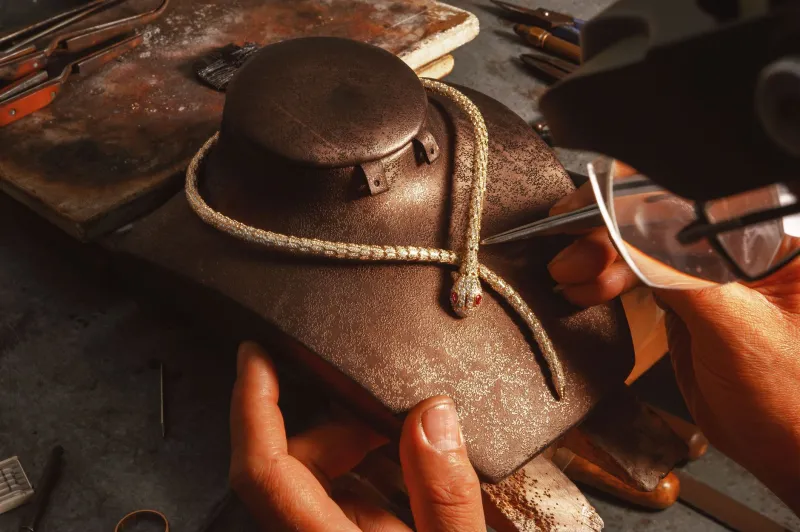
The word "bespoke" has suffered considerable dilution in recent years. It has been applied to everything from made-to-measure suits to personalized sneakers, until the term risks losing the specific gravity it deserves. In the context of fine jewelry, however, bespoke retains its original meaning with full force: a piece conceived entirely for one individual, shaped by their aesthetic vision, their personal history, and the collaborative intelligence of master craftspeople who have spent decades perfecting their discipline.
For American collectors considering their first commission — or their first commission at this level of ambition — the process can feel opaque. What actually happens between the initial conversation and the finished piece? How long does it take? How much creative input is realistic to expect, and how much should one defer to the designer's judgment? What does it mean to select a stone before a setting exists?
These are not small questions, and they deserve considered answers.
The Consultation: More Than a Brief
The process begins not with a sketch but with a conversation, and the quality of that conversation will determine everything that follows. A first consultation with a master jeweler or atelier design director is not a transaction. It is a form of listening — on both sides.
The collector who arrives with a single reference image and says "I want something like this" has provided a starting point, but not a brief. A genuinely useful consultation involves articulating not just aesthetic preferences but the context in which the piece will be worn, the emotional register it should occupy, and the relationship it bears to pieces the collector already owns. Is this a daily piece or an occasion piece? Should it feel like an inheritance or an arrival? Is the collector drawn to material richness, structural complexity, or both?
At ateliers where Japanese precision manufacturing informs the process, these conversations carry particular weight. Japanese craft traditions place enormous emphasis on understanding purpose before beginning execution — the notion that a well-made object must first be a well-understood object. Design directors trained in this lineage will ask questions that American clients sometimes find unexpectedly philosophical. Lean into them. The answers will produce a better piece.
Timeline: The Honest Version
One of the most common sources of disappointment in bespoke commissions is misaligned timeline expectations. A fine jewelry commission of genuine ambition — original design, custom stone selection, hand-finishing — requires a minimum of twelve to sixteen weeks from approved sketch to delivery. More complex pieces, or those requiring exceptional or rare materials, may require six months or longer.
That timeline breaks down roughly as follows: two to four weeks for initial sketches and design iterations; one to three weeks for stone sourcing and selection; four to eight weeks for fabrication; and one to two weeks for finishing, quality review, and final adjustments. At any stage, revisions may extend the schedule, which is why the consultation and sketch phases deserve as much time as they need.
Collectors who approach bespoke commissions with a deadline — a birthday, an anniversary, a milestone event — should communicate that constraint immediately and honestly. A reputable atelier will tell you whether the timeline is feasible. If they say it is not, believe them. A piece rushed through fabrication is not a bespoke piece; it is a compromise with a custom price tag.
The Sketch Phase: Learning to Read What You See
For collectors without formal design training, the sketch phase can be disorienting. Technical jewelry drawings are not always immediately legible — proportions may appear exaggerated, shading conventions are specific to the discipline, and the flat rendering of a three-dimensional object requires a certain imaginative translation.
The most productive approach is to ask questions rather than make immediate judgments. Ask the designer to indicate scale on the drawing. Ask how a particular element will read in profile. Ask where the light will catch the piece in different conditions. Italian design ateliers, with their tradition of presenting work through multiple views and material samples, are often particularly skilled at making sketches accessible to non-specialists.
Expect at least two rounds of revisions before a sketch is approved for fabrication. Three rounds is not unusual. The willingness of a skilled designer to iterate is not a sign of uncertainty; it is a sign of commitment to getting the piece right before any metal is cut or any stone is set.
Material Selection: The Decisions That Cannot Be Undone
Of all the decisions in a bespoke commission, material selection carries the most permanent consequences. A setting can be adjusted; a stone cannot be unset without risk. This is the phase that rewards the most deliberate attention.
For collectors working with colored stones, the selection process involves evaluating not just color and clarity but the stone's behavior in different light — daylight, artificial light, candlelight — and its relationship to the collector's own skin tone. A fine emerald that photographs magnificently may read quite differently against the collector's complexion in a restaurant. Ateliers that source stones directly, rather than relying on a single supplier, offer considerably more flexibility in finding the right match.
For collectors working primarily in diamonds, the Japanese precision manufacturing tradition offers a particular advantage: an exacting approach to cut quality that prioritizes light performance over carat weight. A well-cut stone of modest size will outperform a poorly cut stone of greater weight in virtually every real-world condition. This is a principle worth holding firmly during the selection process, particularly when presented with impressive weight at a lower price point.
Communicating Vision Across Culture and Craft
For American collectors commissioning through ateliers that blend Japanese and Italian craft traditions — as Anelli Nagaoka's design philosophy does — there is an additional dimension of communication worth acknowledging. Different craft cultures carry different assumptions about the relationship between client and maker.
In the Japanese tradition, the maker's expertise is understood to be a form of service — not servitude, but genuine devotion to the client's needs. This means that a Japanese-trained craftsperson will take direction seriously and execute it with extraordinary fidelity, even when their own aesthetic instincts might suggest a different approach. The implication for collectors is that vague direction will produce a vague result. Precision in your brief will be met with precision in execution.
In the Italian design tradition, the designer's point of view is considered part of the value proposition. A great Italian jewelry designer is not simply a skilled executor of your ideas; they are a creative collaborator whose perspective should be treated as a resource. The best commissions through this tradition involve genuine dialogue — the collector brings the intention, the designer brings the language.
The convergence of these two approaches, which is precisely what distinguishes the finest cross-cultural ateliers, produces bespoke work of unusual depth: pieces that are both faithful to the collector's vision and elevated by a design intelligence that the collector could not have accessed alone.
The Piece That Becomes Part of the Story
A bespoke commission, approached with the seriousness it deserves, does not produce a product. It produces a narrative object — a piece of jewelry whose meaning is inseparable from the process of its creation. Collectors who have been through this process once rarely commission any other way afterward.
The time, the conversation, the iteration, the waiting — these are not inconveniences to be minimized. They are the conditions under which something genuinely personal becomes genuinely fine. Before the first sketch, that understanding is the most valuable thing a collector can bring to the atelier.