Both at Once: The Luxury Paradox of Wanting Everything and Nothing
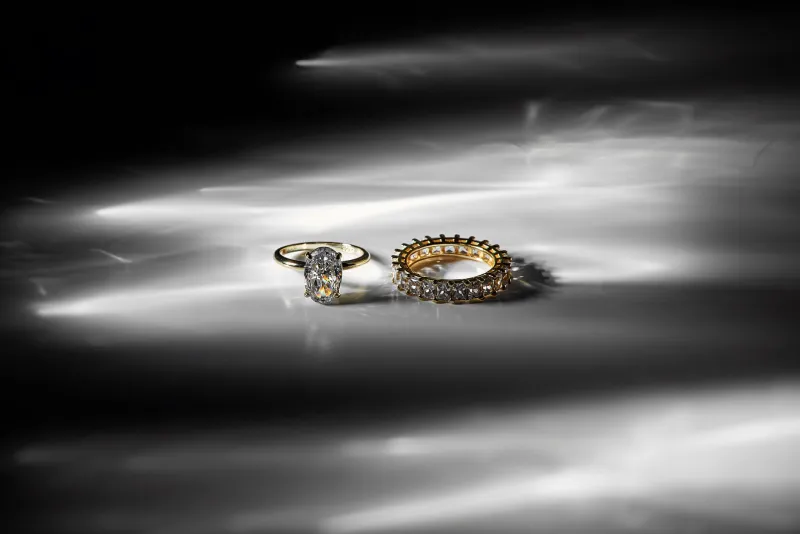
There is a particular moment that anyone who has stood before a jewelry counter knows well. You are drawn to the piece that commands the most attention in the case—the one with architectural scale, deep color, almost theatrical presence. And then, almost immediately, you are drawn to the piece beside it: spare, considered, a single element so refined it barely seems to exist. You want both. You feel faintly embarrassed that you want both. And then you wonder if perhaps wanting both is the most honest thing you have felt in a long time.
This is not indecision. It is the defining tension of contemporary American luxury taste, and it deserves to be taken seriously.
Two Philosophies, One Lineage
Anelli Nagaoka was built on a premise that most design houses would consider a liability: the deliberate collision of two aesthetic traditions that, on the surface, have no business sharing the same sentence. Japanese minimalism—rooted in ma, the philosophy of meaningful negative space—prizes what is withheld above what is given. Italian maximalism, born from centuries of goldsmithing excess in cities like Florence and Vicenza, insists that beauty is a form of generosity that should never be rationed.
Put them together and you have, depending on your perspective, either a contradiction or a conversation. Anelli Nagaoka has always believed it is the latter.
The name itself encodes this duality. Anelli is the Italian word for rings—plural, abundant, celebratory. Nagaoka is a Japanese surname that carries the quiet gravity of a family lineage, something earned across generations rather than announced. The brand does not resolve the tension between these two words. It inhabits it.
The American Consumer Who Refuses to Choose
For decades, the American luxury market was organized around a relatively stable binary. There were statement buyers—those who sought jewelry as declaration, as arrival, as unmistakable social signal. And there were investment buyers—those who sought pieces that would endure precisely because they never demanded attention. The two groups shopped differently, dressed differently, and rarely felt the other group quite understood what jewelry was actually for.
Something shifted around the mid-2010s, and it has only accelerated since. The emergence of a generation of collectors who grew up fluent in both streetwear and couture, who could cite Noguchi and Bulgari in the same breath, who had been to Tokyo and Milan and came home unable to fully commit to either—this cohort did not want to choose a lane. More importantly, they became suspicious of any brand that asked them to.
The collector who wears a single flawless akoya pearl on a barely-there chain to a board meeting, then layers three gold cuffs of increasing width for a Saturday dinner—this is not someone with an inconsistent aesthetic. This is someone with a fully developed one. Their wardrobe contains multitudes. Their jewelry should too.
Where Restraint Becomes the Statement
The most misunderstood quality in Japanese design philosophy is that minimalism is not the same as simplicity. A piece can be stripped of ornament while remaining extraordinarily complex in its geometry, its finish, its relationship to the body. Anelli Nagaoka's approach to this tradition manifests in pieces where the drama lives entirely in proportion.
Consider a wide, flat band in oxidized silver, its surface interrupted by a single recessed line that travels the circumference of the ring. There is nothing decorative here in the conventional sense—no stone, no filigree, no engraving that tells a story in words. And yet the piece stops people. It stops them because the restraint is so absolute that it reads as confidence, and confidence at that scale is its own form of extravagance.
This is the Japanese contribution to the paradox: the understanding that withholding can be a maximalist act when it is done with full commitment.
Where Abundance Becomes Precision
Italian goldsmithing does not apologize for its appetite. The tradition that produced Castellani's archaeological revival pieces, that refined granulation to a near-mythological craft, that gave the world the parure as a complete theatrical statement—this is a tradition that believes more is a valid answer to almost any design question.
But the Italian maximalism that informs Anelli Nagaoka is not the maximalism of accumulation for its own sake. It is the maximalism of mastery: the understanding that you can only pile form upon form, texture upon texture, if every individual element has been resolved with the same precision you would give a solitary piece. The excess earns its right to exist through the rigor of its execution.
A multi-strand necklace in 18-karat yellow gold, each link hand-finished to a slightly different reflectivity so that the piece catches light as a living surface rather than a uniform one—this is Italian abundance filtered through Japanese attention. The result is something that reads as lush and considered simultaneously. It is not trying to be subtle. But it has been made with the same care that subtlety demands.
The Paradox as Design Principle
What Anelli Nagaoka has understood, and what the most sophisticated segment of the American market has begun to articulate in its buying behavior, is that the opposition between minimalism and maximalism is far more productive than any resolution of it would be.
A piece that is purely minimal offers one kind of pleasure: the satisfaction of reduction, of everything unnecessary stripped away. A piece that is purely maximal offers another: the pleasure of abundance, of craft made visible, of decoration as a form of joy. But a piece that holds both impulses in genuine tension—that is minimal in its silhouette and maximal in its surface, or maximal in its scale and minimal in its palette—offers something rarer. It offers the experience of being surprised by something you already understand.
This is why certain Anelli Nagaoka pieces seem to shift character depending on the context in which they are worn. A wide hammered cuff in pale gold reads as architectural severity in a spare white shirt; the same cuff reads as sensuous abundance over a silk blouse. The piece has not changed. The weighting of its contradictions has.
Longing as an Aesthetic Category
The word longing carries a specific emotional charge that most luxury brands are reluctant to engage with directly. Longing implies incompleteness. It implies that desire has not been satisfied—and the entire machinery of luxury retail is organized around the premise that desire can be satisfied, if only you acquire the right thing.
But longing, understood properly, is not about lack. It is about the sustained experience of wanting something that resists full possession. The most enduring jewelry pieces function this way. You wear them for years and they continue to reveal themselves. You see them from a new angle in a different light and something shifts. The piece you thought you knew turns out to have been withholding something.
That quality—the capacity to remain slightly out of reach even after you have acquired the thing—is what the Japanese-Italian paradox at the heart of Anelli Nagaoka is ultimately designed to produce. Not a piece that resolves your desire. A piece that dignifies it.