Worn With Intention: The American Collector's New Reverence for Jewelry That Ages Beautifully
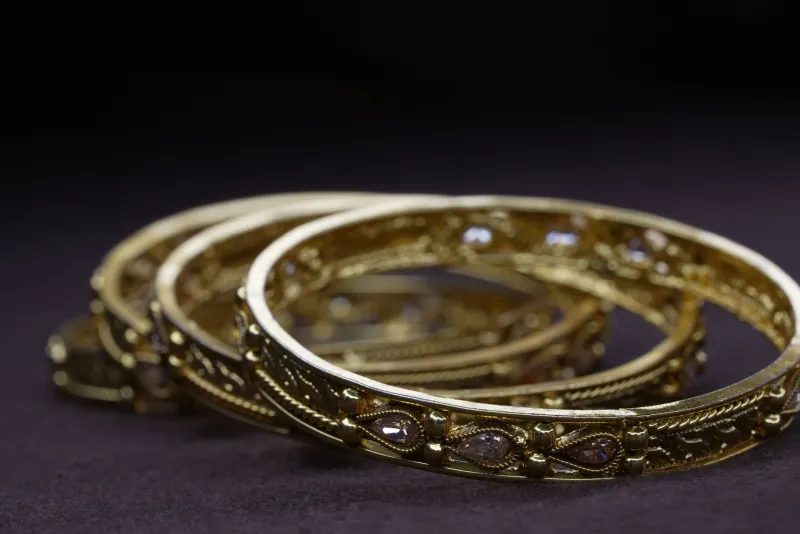
There is a particular kind of beauty that cannot be manufactured. It arrives slowly, accumulated through decades of contact with skin, air, and memory. A gold band softened at its edges. A silver clasp whose surface has deepened from bright to burnished. A patina that no jeweler's polishing cloth could replicate, because it was made not in a workshop but in a life.
American luxury consumers have long been conditioned to equate value with perfection—the unblemished surface, the mirror finish, the piece that looks precisely as it did the day it left the atelier. Yet something is shifting. Among a growing segment of discerning collectors, the polished-perfection narrative is losing its authority. In its place, a more nuanced and philosophically rich appreciation is emerging: one that finds meaning in the marks time leaves behind.
The Philosophy Behind the Imperfect
To understand this movement, one must first understand wabi-sabi, the Japanese aesthetic framework that locates beauty in transience, incompleteness, and the natural processes of aging. The concept resists easy translation—it is less a design principle than a way of perceiving the world. Where Western luxury traditions have historically celebrated permanence and polish, wabi-sabi invites the observer to find elegance precisely in what is fleeting and worn.
This philosophy has long informed Japanese metalworking and lacquerware traditions, where artisans deliberately leave evidence of the hand, the tool, and the passage of time. When paired with Italian craftsmanship's deep respect for materials that mature gracefully—leathers that soften, metals that develop patina nobile—the result is a design sensibility that treats aging not as deterioration but as completion.
At Anelli Nagaoka, this dual inheritance shapes how we think about every piece we curate. A ring is not finished when it leaves the bench. In many ways, it has only just begun.
Collectors Speak: The Emotional Weight of a Worn Surface
Speaking with collectors across the United States, a consistent theme emerges: the pieces they reach for most often, the ones they describe with the most feeling, are rarely the newest or the most pristine. They are the pieces that carry history.
A collector in Boston describes a rose gold bracelet inherited from her grandmother—its surface no longer uniformly bright, its texture softened by decades of daily wear. "A jeweler once offered to restore it," she says. "I declined immediately. Those marks are my grandmother's days. Polishing them away would be a kind of erasure."
A collector in Santa Fe speaks of deliberately wearing his most significant pieces rather than storing them. "I want them to record my life the way a journal does. The scratches on my signet ring are a timeline. I know which ones came from which years."
These are not isolated sentiments. They reflect a broader cultural recalibration—one in which provenance, narrative, and lived authenticity have become as valuable as material rarity.
The Artisan's Perspective: Designing for Time
For craftspeople working within the tradition that Anelli Nagaoka represents, the question of how a piece will age is inseparable from the question of how it is made. Materials are selected not only for their initial appearance but for the character they will develop. High-karat gold alloys chosen for their particular warmth as they wear. Silver compositions that develop a specific depth of tone over years rather than decades. Surface treatments that invite rather than resist the evidence of use.
Italian goldsmithing traditions, particularly those rooted in the workshops of Florence and Vicenza, have long understood that a piece's relationship with time is part of its design. The concept of invecchiamento nobile—noble aging—describes the process by which quality materials become more distinguished, not less, as they accumulate wear. This is a principle that separates genuinely fine jewelry from its imitations: lesser materials degrade; exceptional ones evolve.
Japanese metalworking traditions add another dimension. Techniques such as mokume-gane, which layers different metals to create organic, wood-grain patterns, produce surfaces that interact with light differently as they age, revealing new qualities over time. The piece one owns at twenty is not quite the same piece one wears at fifty—and that transformation is not incidental but intrinsic.
Why This Matters Now
The timing of this shift is not accidental. American luxury consumers have grown increasingly skeptical of surfaces—in goods, in marketing, in culture broadly. The hyper-curated aesthetic of the past decade, in which everything was filtered, perfected, and presented without flaw, has generated a corresponding hunger for the genuine, the textured, the real.
Fine jewelry that ages visibly offers something that few luxury categories can match: irrefutable proof of authenticity. A patina cannot be faked in any meaningful sense. It is the physical record of a specific object's specific history. In a market where provenance and authenticity are increasingly central to value—both financial and emotional—this matters enormously.
There is also a sustainability dimension that resonates with younger collectors in particular. A piece designed to be worn, to show wear, and to be passed on is by definition a piece designed for longevity. It is the antithesis of disposability. The collector who embraces patina is making a statement about permanence, about the relationship between objects and time, about what it means to own something truly.
The Practice of Intentional Wearing
For those new to this philosophy, the shift requires a certain conscious unlearning. The instinct to remove fine jewelry before swimming, gardening, or sleeping—to preserve it in its original condition—is deeply ingrained. And there are, of course, practical considerations: some stones require protection from certain chemicals, and structural integrity always takes precedence over aesthetic philosophy.
But within those parameters, there is significant room for intentional engagement. Wearing a piece consistently, allowing it to develop a relationship with your particular body chemistry, your daily environments, your habits of movement—this is how a fine object becomes a personal one. This is how jewelry acquires the quality that no atelier can supply at the point of sale: the quality of belonging to you specifically, and only you.
At Anelli Nagaoka, we believe that the most valuable piece in any collection is not the most expensive or the most technically complex. It is the one that has been worn with intention, carried through significant moments, and allowed to record the passage of time in its surface. That piece, whatever its material value, is irreplaceable.
Beauty, as the Japanese have long understood, is not a fixed state. It is a process. And the most beautiful things are often those that have been lived in most fully.