The Trust Deficit: How the Certification Landscape Is Being Rebuilt From the Ground Up
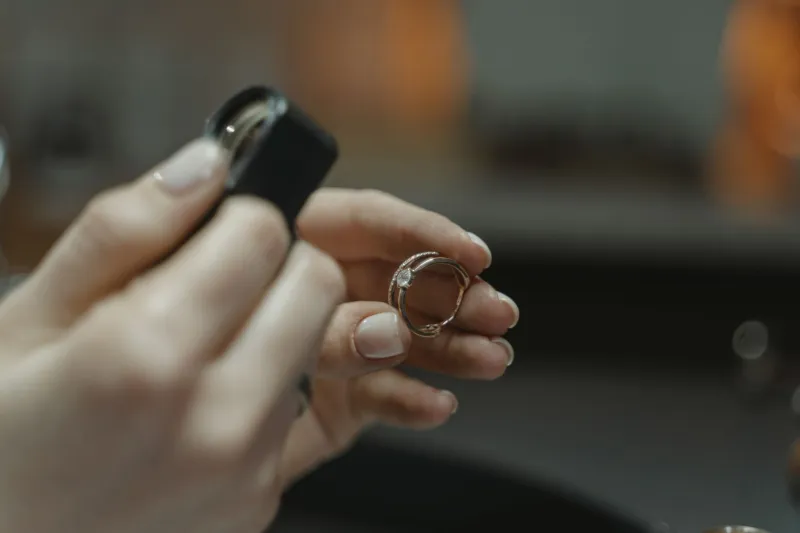
For decades, a hallmark was considered sufficient evidence of quality. Today, the most discerning jewelry collectors in America are asking questions that no stamp or certificate was designed to answer. The industry's response—ranging from laboratory grading reports to blockchain-anchored provenance records—reveals as much about the erosion of institutional trust as it does about the advance of technology.
We are living through a fundamental reassessment of what it means to verify a luxury object. And for those of us who care about the integrity of fine jewelry—its materials, its making, and its meaning—this reassessment is long overdue.
What a Hallmark Actually Tells You
The hallmark is among the oldest consumer protection mechanisms in existence. English assay offices have been stamping silver and gold since the fourteenth century. The system is elegant in its simplicity: an independent authority tests a metal's composition and applies a mark that communicates that finding to anyone who knows how to read it. A 750 stamp on a gold piece tells you, reliably, that the alloy is 18 karat. A Platinum 950 designation communicates a specific purity threshold.
What a hallmark cannot tell you is whether the stone set into that metal was ethically sourced, whether the craftsmanship meets the standards implied by the price, or whether the piece has been repaired, altered, or misrepresented somewhere in its chain of custody. These are not minor omissions. For a collector spending five figures or more on a single acquisition, they represent significant blind spots.
The hallmark was designed for a world in which the maker, the seller, and the buyer often occupied the same city. In a global luxury market, it is a necessary but insufficient foundation.
The Laboratory Era and Its Discontents
The rise of independent gemological laboratories—most prominently the Gemological Institute of America, whose grading reports have become near-universal currency in the diamond trade—represented a meaningful advance. A GIA report attaches a specific stone to a specific set of measurements: carat weight, color grade, clarity grade, cut grade. For buyers navigating a market where subjective descriptions had long served sellers better than buyers, this standardization was genuinely valuable.
Yet the laboratory era introduced its own complications. Report inflation—the perception, documented in industry research, that some laboratories apply more generous grades than others—created a market in which the issuing institution became as important as the grade itself. Collectors learned, sometimes expensively, that a certificate from a less rigorous laboratory could accompany a stone that a GIA report would grade significantly lower. The certificate became a variable rather than a constant.
More fundamentally, even the most rigorous laboratory report addresses only the stone at the moment of grading. It says nothing about what happened to that stone before it arrived at the laboratory, nor does it follow the piece into the secondary market where most significant jewelry eventually circulates.
Japanese Precision as a Quality Benchmark
It is instructive to consider how Japanese manufacturing culture approaches the problem of verification. The concept of monozukuri—the art and philosophy of making things—encompasses not only the finished object but the entire process by which it was produced. Quality, in this framework, is not a property that is tested at the end of a production cycle. It is a condition maintained throughout every stage, documented at every step, and understood as a collective responsibility rather than an individual claim.
This philosophy has direct implications for jewelry certification. A piece produced under genuine monozukuri principles arrives with an implicit record: the sourcing of its materials, the qualifications of its craftspeople, the tolerances maintained during setting and finishing. The documentation is not an afterthought appended to justify a price. It is the natural output of a process designed with accountability at its center.
When Anelli Nagaoka applies Japanese precision standards to our own production, this is precisely what we are reaching for—not a certificate that validates a finished object, but a process in which every decision along the way is made with the awareness that it will be visible to the person who ultimately wears the piece.
Blockchain and the Limits of Technological Optimism
The most discussed innovation in jewelry authentication over the past decade is blockchain-based provenance tracking. The appeal is obvious: an immutable, distributed ledger that records every transfer of ownership and every material claim, theoretically making fraud impossible and accountability permanent.
The reality is more qualified. Blockchain verification is only as reliable as the data entered into it. If a diamond is described inaccurately at the point of initial entry into the chain, the blockchain will record and preserve that inaccuracy with perfect fidelity. The technology addresses the problem of records being altered after the fact, but it does not address the problem of records being falsified at the point of origin. In an industry where provenance claims have historically been difficult to verify independently, this is not a trivial limitation.
What blockchain does accomplish, when implemented honestly, is raising the cost of deception. Committing to a public, permanent record creates accountability that a paper certificate, easily reproduced or altered, does not. For collectors who understand both the technology's capabilities and its constraints, blockchain provenance can be a meaningful additional layer of confidence—not a replacement for expertise, but a supplement to it.
What Discerning Collectors Should Actually Demand
The most practically useful shift in collector behavior is not toward any single certification standard but toward a broader demand for transparency at every stage of acquisition.
This means asking not only for a grading report but for information about where a stone was mined and under what conditions. It means requesting documentation of any repairs or alterations to a piece. It means understanding the reputation and methodology of the craftspeople and suppliers involved in production, not merely the name on the final label.
It also means developing enough personal knowledge to evaluate the answers received. A collector who understands the difference between laboratory grading standards, who can read a hallmark and know what it does and does not communicate, and who has built relationships with craftspeople whose integrity is demonstrated rather than merely claimed—that collector is not dependent on any single certification system. They have built their own verification capacity.
This is, ultimately, the direction in which the luxury market is moving: away from institutional proxies for quality and toward direct, informed engagement with the objects and the people who make them. The certification wars have not produced a single winner. They have produced a more sophisticated buyer.
At Anelli Nagaoka, we regard that outcome as progress.