Where Angles Meet Arcs: The Design Philosophy Behind Jewelry That Speaks to Both Mind and Heart
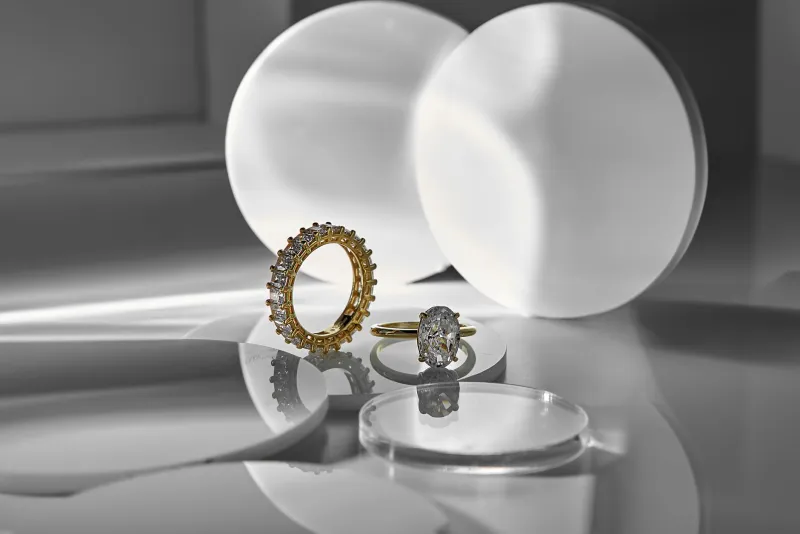
There is a particular kind of beauty that announces itself slowly. It does not dazzle upon first glance; it earns your attention through a kind of structural logic — a line that ends precisely where it should, a curve that arrives like a breath held and then released. This is the beauty that emerges when Japanese geometric sensibility and Italian curvilinear tradition are brought into deliberate conversation, and it is reshaping the finest jewelry collections available to American collectors today.
At Anelli Nagaoka, this tension is not merely aesthetic — it is foundational. The name itself gestures toward this duality: anelli, the Italian word for rings, paired with a Japanese surname that evokes precision, lineage, and craft. To wear a piece conceived at this intersection is to carry two philosophies simultaneously, each amplifying the other in ways that neither could achieve alone.
The Japanese Principle: Structure as Meaning
In Japanese design philosophy, the silhouette is not decoration. It is argument. The tradition of katachi — the idea that form itself communicates meaning — runs through everything from temple architecture to lacquerware. When applied to jewelry, this principle produces pieces defined by deliberate angles, negative space, and a resistance to excess that borders on the devotional.
Consider the way a Japanese-influenced cuff bracelet might be engineered: flat planes of hammered gold meeting at precise junctions, the interior surface left intentionally unpolished to contrast with the mirror finish of the exterior. Nothing is accidental. The geometry is not ornamental — it is the ornament. Each angle carries intention, and that intention is legible to the wearer even when it is invisible to the observer.
This approach resonates deeply with the American collector who has grown weary of jewelry that performs loudly without saying anything. Across the country's most discerning markets — from Manhattan's Upper East Side to the quieter galleries of San Francisco's Pacific Heights — there is a growing appetite for pieces that reward sustained attention. Japanese minimalism offers exactly that: a visual grammar that unfolds over time.
The Italian Sensibility: Form as Feeling
Italian jewelry design operates from an entirely different premise. Where the Japanese tradition asks what does this mean, the Italian asks how does this feel. The great houses of Valenza, Vicenza, and Florence have spent centuries refining an approach that treats the human body as collaborator rather than mannequin. Curves are not arbitrary; they are calibrated to the specific topography of a wrist, a collarbone, a finger.
This is jewelry conceived in motion. A Florentine goldsmith working in the classical tradition understands that a necklace exists in two states — on the velvet display stand and against warm skin — and that only the second state truly matters. The voluptuous sweep of an Italian collar, the way a serpentine bracelet articulates with each gesture of the hand, the slight asymmetry introduced to make a ring feel organic rather than manufactured: these are design decisions rooted in centuries of watching how people actually inhabit their adornments.
For the American collector, this tradition offers something the market has increasingly sought: emotional permission. The sensuous curve of a well-made Italian piece communicates that beauty is not austere, that luxury can be warm as well as cool, and that a fine jewel should feel like an extension of the self rather than an artifact placed upon it.
The Productive Tension: When Opposites Refuse to Cancel Each Other Out
The most sophisticated contemporary jewelry does not choose between these two traditions — it holds them in productive tension. This is considerably harder than it sounds. A piece that tips too far toward Japanese severity risks feeling cold, unapproachable, more sculpture than jewelry. One that surrenders entirely to Italian sensuality can lose the structural clarity that gives a silhouette its staying power.
The designers who navigate this balance most successfully tend to describe their process in similar terms: beginning with geometric logic and then introducing organic interruption, or starting with a fluid form and imposing structural discipline at specific junctures. The result, in both cases, is a silhouette that reads as simultaneously inevitable and surprising.
A contemporary example worth examining: the emergence of the asymmetric ear cuff as a dominant fine jewelry form over the past several years. The most compelling iterations of this piece combine a precisely engineered geometric frame — often in white gold or platinum, with angles that recall architectural draftsmanship — with a flowing element, perhaps a curved bar of pavé diamonds or a single pear-shaped stone suspended at an angle that defies expectation. The geometry provides the intellectual anchor; the curve provides the emotional release. Neither element would be sufficient on its own.
Reading the American Collector's Response
It would be a mistake to attribute the American market's enthusiasm for this design duality to mere trend-following. The collectors who seek out pieces that embody both traditions are, by and large, people who have already passed through the stage of purchasing jewelry as status signal. They have worn the obvious pieces, understood what those pieces communicate, and found that communication insufficient.
What they seek now is jewelry that reflects a more complex self-understanding — an acknowledgment that sophistication is not a single note but a chord. The person who appreciates the disciplined geometry of a Japanese-influenced setting while also responding to the sensual warmth of an Italian-crafted band is not experiencing a contradiction. They are expressing a wholeness.
This is, perhaps, the deepest argument for the design philosophy that Anelli Nagaoka embodies. The tension between precision and fluidity, between intellectual rigor and emotional availability, is not a problem to be resolved. It is the point. A piece that achieves genuine balance between these poles does not ask the wearer to choose which version of themselves to present to the world. It accommodates both.
Practical Guidance for the Discerning Collector
For those building a collection with this philosophy in mind, a few principles are worth carrying into the process of selection.
First, examine the transition points. In any piece that combines geometric and organic elements, the quality of the design lives in how those elements meet. A clumsy junction — where a straight line simply abuts a curve without any mediating logic — reveals a designer who has assembled rather than conceived. A masterful transition, by contrast, feels as though the two elements were always part of the same thought.
Second, consider the piece in motion. Japanese-influenced jewelry often reveals its depth when still; Italian-influenced work frequently requires movement to be fully appreciated. A piece that synthesizes both traditions should reward both states. Hold it in your hand before you wear it, then observe how it changes when it is alive against your skin.
Finally, trust the pieces that require time. The most enduring silhouettes — those that will remain in a collection for decades and eventually pass to the next generation — are rarely the ones that declare themselves immediately. They are the ones that reveal new dimensions with each wearing, that feel differently in morning light than in candlelight, that seem to grow more beautiful as the wearer grows into them.
This is the quiet promise of jewelry conceived at the intersection of Japanese precision and Italian grace: not that it will impress everyone who sees it, but that it will continue to matter to the one who wears it. In the long arc of a collector's life, that distinction is everything.